How do we make human 3D models not only more relevant — but also reproducible enough for decisions?
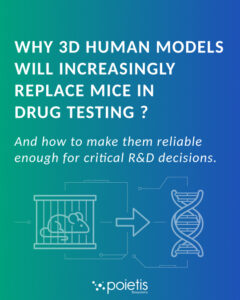
1) Why 3D human models will increasingly replace mice in drug testing
How do we make human 3D models not only more relevant — but also reproducible enough for decisions?
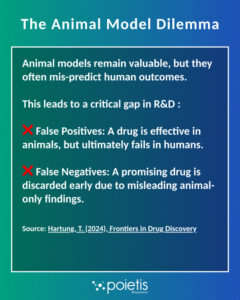
Animal models are still valuable — but they can mis-predict human outcomes, leading to false positives (effective in animals, fails in humans) and false negatives (discarded due to animal-only findings).
Source: Hartung, T. (2024), Frontiers in Drug Discovery
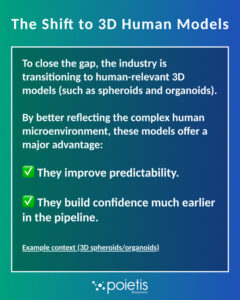
That’s why the industry is shifting toward human-relevant 3D tissue models that better reflect human microenvironments, improving confidence earlier in the pipeline.
Example context (3D spheroids/organoids)
2) How Poietis Biosystems contributes to this change
Where Poietis’ NGB creates real value (benefits, not buzzwords):
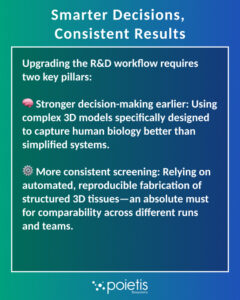
- Stronger decision-making earlier: complex 3D models designed to better capture human biology than simplified systems
- More consistent screening: focus on reproducible, automated fabrication of structured 3D models (critical for comparability across runs/teams)
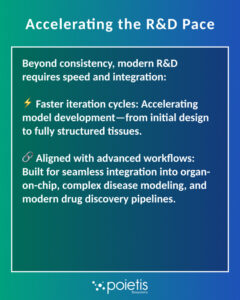
- Faster iteration cycles: accelerate model development from design to structured tissues to support R&D pace
- Aligned with advanced workflows: highlighted use cases in organ-on-chip, disease modeling and drug discovery
→ Our post about “Revolutionizing Organ-on-Chip Models with Next-Generation Bioprinting”
3) Regulatory and ethical matters
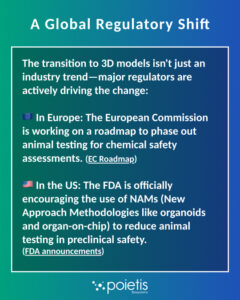
Europe is moving too: the European Commission is working on a roadmap to phase out animal testing for chemical safety assessment – (EC Roadmap)
In the US, the FDA is also encouraging the use of NAMs (e.g., organoids, organ-on-chip, in silico models) to reduce animal testing in parts of preclinical safety – (FDA announcements)
WHAT’S YOUR BIGGEST CHALLENGE WITH 3D MODELS ?
Let’s discuss about NGB-RTM
CONTACT US FOR A DEMO – Or – Follow us on Linkedin